Showing posts with label workshop. Show all posts

Sunday, May 27, 2012

Start Stringing your Puppy with the "Heart Strings"

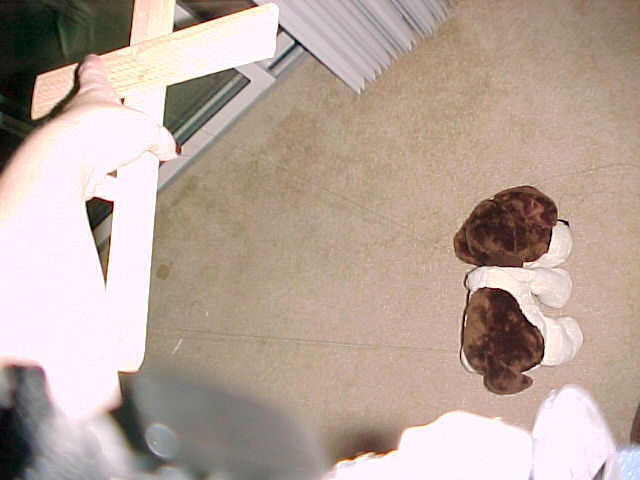
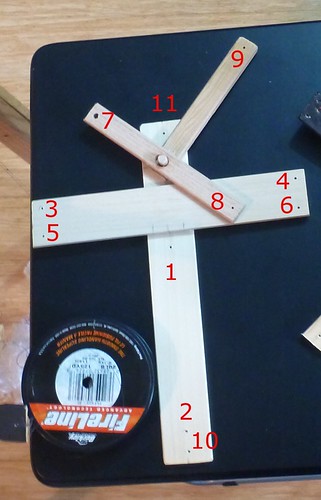
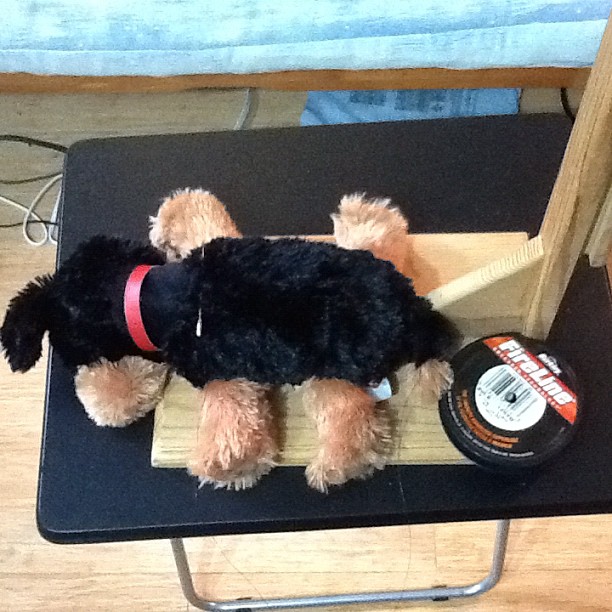
You need a black fishing line for stringing your puppy. The clear plastic fishing line will work but it really does stand out a surprising amount and I have been told it stretches. I have not had many problems with that because my puppets are generally too light weight to matter. Most rag doll style puppets are very light weight. So is a stuffed animal with a few bean bags and lead egg weighs in it. You are also going to need a large needle. You can also see a stringing stand in this picture and that is a great tool for solo string efforts. If you don't have one, I have used split doors, shelves, slide out cutting boards and victims...er...I mean family members or friends. Thanks to all who have patiently held controls for me before!
 We will start with the shoulder string (1) and the posterior string (2) which are the main two support strings. They will carry the full weight of the puppet. They are the heart strings too...the only two strings that if cut, will kill the performance completely. The control must be held level and the strings set so that all four feet are just barely touching the ground.
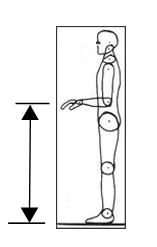
I use this diagram to show where it's best to hold the controls for the person who will be using this puppy in performance:
 This assumes that the person who is in this diagram is full grown and plans to use this puppet on the floor and walking about in a room.  For a child, you might add a few inches for when they grown a bit more or if you are planning on performing on a bridge, you need to stand on the bridge to get the right length. Conversely, if you plan on performing on a table, the puppet needs to stand on that table to get the right length.
Next Post will discuss the leg strings.

Sunday, July 19, 2009

Friday Workshop

Philip
I just took one today. I went to the Instructional Center to learn about Italian Punch—Pulcinella…for a bit…until we all were informed that Georgia Tech had once again double booked the class room. Allow me to say that again emphasizing the key points: The Georgia Institute of TECHNOLOGY once again double booked a classroom. Now, that’s just sad, isn’t it? I mean…we do have the scheduling TECHNOLOGY to not do this…it does exist. But I digress.
The workshop was lead by Philip Farah and called “Pulcinella and Commedia dell’ Arte hands on techniques”. Pulcinella is a bit more stylized than its English counterpart. He also looks a great deal different. He wears all white clothes and a black plain (for Commedia dell’ Arte, that is) mask. His motions involve a lot more rhythmic hitting and slapping of the playboard—with not only his hands, but also his face and the back of his head. The characters he plays with are different as well. For example, there is no wife—only a beautiful fiancé which he loves and wants to marry but never gets to. This is not stock, however, because sometimes Pulcinella is not male. In Italy, Pulcinella isn’t just ‘Every-man’; he’s also ‘Every-woman’ depending on the skit at the time. Odd…and difficult to wrap one’s mind about, but true.
He faces off against Death rather than the Devil, but that’s one war he can’t win…just put off for another day. His neighbor is a true villain…and like in England the story really has no non-villains—except possibly the fiancé who isn’t a glove puppet like the rest. She is single stick rod puppet with very little controls and looks like a doll on a stick. Now there is an authority figure that sends Pulcinella off to the hangman, which is the same to a point. For the scene with the hangman is extremely bawdy in its use of the hole presented by the noose. Never thought of that before, I assure you.
There are no huge noses in a Pulcinella set…because there is a lot of beating of the heads against everything: the stick, the playboard, the heads of other characters, etc.
The Italian system of the passing of the torch involves Apprenticeships, which Philip described in great detail. The most striking task being the using of a huge swazzle to make one’s mouth bleed until one’s palette develops calluses. Ouch. I’m glad that I could make my swazzle for my mouth rather than adapt my mouth to a swazzle!

Thursday, July 16, 2009

Thursday Workshops

Kevin shows cap
My first workshop today was attended because Paper-mache is currently my favorite puppet building method to employ and I enjoy very much seeing how other people do it. It was “Lightweight Marionette Bodies using Paper Mache” by Kevin Menegus. He starts in a similar fashion to the Thistle Theatre method which I learned originally from Brian Kooser—with a Styrofoam base. He also employs only 3 layers of thick brown paper. He uses Wheat paste as well. Here’s the differences…he does not use wood glue in the mix. He soaks the paper in water overnight. He sands all lumps away after the first layer. He adds all string supports and wires in between the second and third layers and he does not use any piece of paper with ink printed on it…doesn’t like his paste to turn strange colors. It is a consideration that I handle with gesso after the fact. It was all very interesting indeed, plus good to know that some of the methods I use are universal.

My second workshop was excellent in the fact that it took me out of my comfort zone and into a world that I know very little about: Electrical Design. It was “Do-It-Yourself 600 Watt Stage Dimmer” by Fred E. Putz. I actually learned to make a stage dimmer. And guess what? I took a series of pictures to show you how it’s done. See:
00 - What you need
Now I too can dim!

Wednesday, July 15, 2009

Wednesday Workshops

Q&A with Video Service Consultant
My first workshop was with Lee Armstrong: Video 101 for Puppeteers. It was a Q&A session for how to put together a demo reel or a puppet shoot. There were many questions and many answers, but my goal was satisfied without me saying a word. I wanted to know what software people use and recommend. Lee uses Adobe Primer Pro, and others had good things to say about the slimmer version: Adobe Primer Express. Many used and liked a software called "Final Cut". Others mentioned liking iMovie(the older version not the current one) and Vegas Video. One puppeteer spoke out strongly against Moviemaker...sorry Microsoft.
Adapting Books to Puppet Shows
My second workshop was with Paul Mesner: Adapting Contemporary Children's Literature for the stage. He went through stories of seeking permission for about a dozen books. He talked about the hurdles he went through and his interactions with the author/artists of the books. He also answered a long standing question in my mind...why no Dr. Suess or Shel Silverstien puppet shows? The estates are too tight fisted, which is a real shame.

Saturday, April 25, 2009

Event Annoucement--Day of Puppetry for Puppeteers in Ballard

On May 16, 2009, the Puppeteers of Puget Sound [http://www.geocities.com/pofps/] will be hosting a Day of Puppetry for Puppeteers in Ballard.

This is a day dedicated to showcasing the work of local puppeteers. Showcase performers will be announced on the website [http://www.geocities.com/pofps/] May 1, 2009.

The event itself will occur at the Sunset Hill Community Club
[http://www.sunsethillcommunity.com/ ] on May 16 with daytime showcase performance times to be announced. There will be a social hour to show off your favorite puppet, a short meeting of the Puppeteers of Puget Sound and a special evening preview of Kyle Loven's Dear Lewis, recipient of a 2009 Jim Henson Foundation Seed Grant.

Please register by RSVPing to the Evite if you got one. If you need an Evite or cannot use Evite send an email to the webmaster at elly_leaverton@yahoo.com. This event is free to Puppeteers of Puget Sound and prospective members. Puppeteers of Puget Sound members who attend the Day of Puppetry will receive a free ticket to Thistle Theatre's 3:00pm performance of the Goblin and the Poet on the day of Puppetry.

Tuesday, February 17, 2009

RadCon 2009

I got pictures! I had 9 students on Saturday if you count the 5 that came super late and played with my glove puppets...which I do. Interest is good.
RadCon 2009 (10)
Four of the nine showed on Sunday...the three who came the whole time on Saturday: Dann, Mary and Andrew plus one of the late comers. Luckily I had prepared some hands so that the second day could stand alone.
I think the convention will try it again next year--the feedback we got was that too many craft workshops were in the morning and not enough kids activities were in the morning. I guess the adults turned up at the kids workshops and were put out. Alas, I think me that there are no gaming early birds! Not only that, but they want a morning place to take their kids while hung-over. Go fig. Here's a shot of Mary, Dann and me:
RadCon 2009 (77)
As for me...I need more puppets like Shippo. I was employed in entertaining folks in long lines on Friday. I need more anime marionettes. Who am I kidding? I need more puppets...I always need more puppets.
Too Closed and Too Open

Sunday, January 25, 2009

No Boring Parts for Students

I’ve been working on materials for my Radcon 2009 Workshop.
Three hours is not a lot of time, so I don’t want to waste it doing things that a person can handle on their own…like covering balloons with Papier-Mâché. This is something I think that everyone probably has done some time or other…probably in elementary school.
It’s something I do for the basic puppet head; however I build and construct so much off of it that most of it will not be seen in the finished head. It needs to be dry and strong though…a nice firm surface to work with.
Pull Handles
Besides…to do six balloons it takes me a whole movie. At least 2 hours with the help of a hairdryer, of course. Plus I know what I’m doing and work pretty fast. I’ll only have three hours total at RadCon.
BTW, can't ask for a better assistant than Domo:
Domo VS Spider

Wednesday, January 21, 2009

What I’m doing for RadCon 2009

Kimono Demo (1)
So last year I was on a kimono panel where I found myself dressing (kitsuke) some of my friends in kimonos much to the amusement of their boyfriends. The other folks on the “panel” were Japanese clothes collectors and though they had nice collections they deferred to me for kimono kitsuke. That’s okay, because I love doing demos. I must’ve done too bad a job either for they asked me back this year. I said yes at which point the ask-er turned me over to the program chair…who happens to be in Greenwood with me…who knows I do puppets. Well one brainstorm lead to another and now I’m giving a workshop on Papier-mâché and its uses for costuming…masks, anime props, Girl Genius Clanks etc.
This is overwhelming if you think about it…sure I do lots of papier-mâché puppets and I’ve done the occasional mask or head piece. The process is the same in all…but how does one teach in 3 hours something that will demonstrate the possibilities without over tasking the students with deciding what they want to make. The answer I’ve come to is: you can’t. If you are going to teach the process, it works the same in all subjects, the first thing that happens after presentation is a highly structured practice. Once a student has practiced it a few times…then they are ready to move into production. I don’t have time to get them that far. So they must make some prop that has some element of mask to it and some element of anime prop as well as something I’m not to bad at myself.
You keeping up so far?
Okay, so I bounced a few ideas off my favorite victim for such an assault (Frank) and we came up with a practice subject that I think just might fill the bill…a head on a stick. Huh? What do I mean? Think jester stick. Think about all those walking stick props you see with snake heads or skulls. Think Card Captor Sakura and her moon-topped staff. Think Inu Yasha and Jaken’s staff. Think a king’s scepter. Think José Jalapeño on a stick. Plus you get to make a smaller version of what could be a mask. Also…it’s a puppet, is it not? Sí, señora!
Now…what do you think of that plan?

Wednesday, August 13, 2008

The state of my workspace

Workspace
Would you look at that? Now...before you say "What a mess!" let me assure you that this is a completely usable state. In fact, this table is shown to you mid-monkey. The monkey has presented a challenge to me as he is one of two rod puppets in the show. Now, rod puppets are usually not difficult...a head rod and two arm rods are usually all that is required. But our monkey needed not only the normal rods but foot rods/controls as well.
I could only think of one place I saw a full body rod puppet on a glove puppet stage and that was the Spring 2007 edition of The Puppetry Journal published by the Puppeteers of America. In this particular edition, a remembrance of Roger Mara also featured the complete design of his bobberhead rod puppets he designed for his production of Paul Bunyan. If you don't have this issue, I recommend that you send for a back issue.
The Bobberhead design was my inspiration for the string controlled legs of the monkey. See:
Monkey Legs

When he was all finished, I discovered a wonderful thing about this design...you can hold both the string bar and the arm bars in the same hand and when you pull back it makes his hands go back while his feet go forward in a monkey knuckle walk! It's so cool! I can hardly wait for you all to see it!

Monday, May 12, 2008

Papier-mâché Instructions

Back in March of 2006 I talked about my papier-mâché. It’s a pretty through article including my recipe and everything. But not only does it bare repeating, but also these things change and evolve over time. So I think it is definitely time to go over it again.
Again, I must start out by giving credit where credit is due: it was Brian Kooser who taught me this style of papier-mâché. (Brian likes to start with a shaped Styrofoam base though…not clay or balloons.)

Repost of my Blog entry on Papier-Mache
By the way, you can’t get this brand of vinyl wheat paste anymore—but there are others.


The first thing I do is get myself a whole bunch of paper grocery bags—preferably of two different colors. At Metropolitan Market you can get white bags. Next I tear off all cut edges and discard them—I also try to remove anything with glue on it (like the area where the handles are attached). I tear the pieces into approximately 5” by 5” sections.

Next, I take a flat bottomed bowl and mix maybe a teaspoon of wheat paste with water. I add water slowly until I get the paste to the consistency of gravy or hair conditioner. Then I add a generous amount of the Elmer’s Wood Glue—lately you can get brown wood glue. I use that now because if there is to be a color in the glue—I’d rather it be brown.

These days, I’m no longer using a clay head to start…instead I start with a water balloon (blown up with AIR). For two reasons really: Number one: I’m not usually making more than one copy of a head. Number two: Japanese paper clay has given me the freedom to add details after the fact and on top of the papier-mâché.

Once I have my balloon blown up to the size I want, I’m ready to begin. To start off, I take a piece of the brown paper and put it in my paste, cover the paper completely with paste, then wad it into a ball and squeeze out the excess paste. I’ll then un-wad the ball and wad it up again. This causes the fibers on the surface of the paper to stand up a little. Sort of like Velcro. When it’s placed on, the layers will grip each other better. I repeat these steps until I have three or four little waded balls ready to go.

Un-wading the first ball and tearing off quarter-sized bits of paper—not strips, I starting at the top and I work down from there. Little pieces are better than strips because you get more overlap that way which adds thickness. Once I cover the balloon completely, I hang it by its tied end on my Daiso sock drier to dry a little—be sure not to cover up the tied end!
Oni Step 1

For the second layer I use the white bags so I can make sure to cover it completely. With the different color, I can easily see holes. It helps to avoid thin areas. For the third layer, I go back to the brown again. Once the third and last layer is dry, I pop and remove the balloon (it rattles around in there if you don’t). A this point, I’m ready to build out with my cardboard, masking tape and sometimes rolled up newspaper to add neck, nose, chin, or whatever else I can do in broad scope. Fine details like eyes, ears and small noses I do with paper clay. Paper clay is heavy though, so as much bulk as I can add with papier-mâché I do.
With a marionette head, I might reconsider that. A heavier head would be more desirable in that case…heavier than just papier-mâché and balloon I mean.
An example of my use of cardboard, masking tape and newspaper:
3rd Build Session (2)

Friday, July 20, 2007

Round those Characters!

0719071546
Today we dived into characterization.
Luman Coad gave us some techniques to determine our main character with--
He asked us to consider:
What one word describes the main character? (Every character has a positive and a negative characteristic).
What is your main character's fatal flaw; what's his or her core quality?
What is the character's goal?

How your character perceives the world is also important:
What values does the character hold?
What justifies an evil action? For the best villains think what they are doing is right.
What is the character's attitude?
What's the character's slant on the situation?

Character Arc or a character should be different at the end of the show.
A character arc may go something like this: At first, the character seeks his goal without thinking. He fails. This is called the first reversal. Next the character considers and tries again. He fails again. Then he has his black moment. The character must change himself and seek his goal for the final climax of the story.
Find at least a key word and two minor descriptive words that represent your main character.

Homework:
Watch for distinctive characterization that revealed by movement.
Make a one minutes action sequence--take a standard fairytale character and make it unique with movement only.

Thursday, July 19, 2007

Advice from the Second Workshop

0719070922
I'm sure you are all panicking by now, thinking that I wasn't going to tell you about the second day of the workshop. Ah such little faith! I was just tired to day, but I'm ready now.

Luman Coad talked a great deal about movement. He advised us to use silence or put in pauses to draw attention to the motion you want clear.
For example, picking up an object might go something like this:
Look at it
Pause
Examine it
Pause
Consider how to lift it
Pause
Put the hands on it
Pause
Tighten the hold
Pause
Lift or heft it
Pause
Walk off with it

He had four things he encouraged us to think about when creating movement:
A. Size
B. Speed
C. Energy
D. Style

When developing movement, try to:
a. Observe people, study what catches your attention about a movement they make
b. Analyze the movement or determine what it is that is unique about it.
c. Simplify it or "Boil it down" to the essential motion
d. Rehearse and experiment the motion with the puppet
e. Apply it to the character--no two puppets will move the same way
f. Refine the movement:
i. How's the speed? Too fast? Too slow?
ii. How does it fit into the rhythm of the series of movement around it.
iii. Determine what effects the energy of the motion:
--The age of the puppet.
--The temperature of the day.
--The mood of the character.
--etc.
iv. Consider clarity--you only have one chance to make sure an audience gets it
v. Give your audience a chance to think, don't rush them through the story.
vi. Consider the size of the movement in relation to the time frame of the story; mix it up; build it up; pull audiences up.
vii. Use follow-through--like in cartoons--step back before rushing forward--the "ready, set, go" method. This is an idea of the action reaction. In the series of picking an object up I listed above, this would be the "tighten the hold" part.
viii. Use contrast--big/small, bold/shy, happy/sad--to get the point across.

Our homework was to watch the performances that day for "sequences of movement that reveal characterization". Also, we are to come up with a sequence of movements to reveal a stereotypical fairytale character--communicate this with motions only. I think I'll go with the village idiot.

Wednesday, July 18, 2007

Thoughts on Wednesday Performances

0718071205

Part of our homework for the workshop I'm in was to watch the performances that day for specific things:
A. Eye focus of the puppets...where are they looking and where are they leading you to look?
B. Take note of any Outstanding movement

So let's go down the list...

The first show I saw today was "The Secret Life of Bugs"...and I must say I was pretty impressed by the movement of the bugs. Also, the bugs had eyes that don't normally lend themselves well to a focus we humans can recognize. There was focus, however, in the human sense. I don't think it detracted. Over all, the show had two major flaws and they weren't movement. First flaw: gentle and soothing music. Second, slow moving bugs (although very realistic) . The combination of these two flaws coupled with it being the afternoon meant I was seriously falling asleep.

The second show was "Hats off to the Sea" which was delightful. Focus was there, but it was difficult for it not to be because the size of the puppets and the smallness of the puppet's eyes meant that it looked good as long as the face was pointed in the right direction. We did only get to see the first half of the show due to bad weather. Bummer. Outstanding movement came from the full body boat that was attached and walked about by the puppeteer. It was a believable thing that it was afloat in water.

Now, "The Mother of All Enemies" was done in Shadow puppet style. Thus eye focus was not something that the puppeteer can control. I think it can be done if a puppet is cut differently or designed with moving eyes, but I've only seen that type of puppets in books. As for movement, well I find shadow puppets to be the style that least allows me to enter into the belief that these moving things are alive. It had nifty bits of business, don't get me wrong, but nothing I would consider "Outstanding Movement". This show was definitely a case of the words of the puppeteer being much more important than the motion of the puppets.

The puppet slam was hosted by two humanettes. A puppet style that has great potential for believable movement. The puppeteer uses his or her own head, so really, all that needs to be worried about is the action of the body dangling under your chin. These two puppeteers, however, did not seem to worry about that and often let their puppets dangle, or position their legs in odd crushed positions. However, good movement in such a setting would be odd. Humor reigns at a puppet slam.

So, did I do my homework right?

Polichinelle supplied me with new bits of business I liked. Some were movement, most were scripted. Here's a morsel for you:
P: Did you see that my friends? That alligator nearly bit off my hump! If he takes that, I'll only have two phallic symbols left!

Sage Advice on the first Workshop Day

0718071020a
The above picture is Rob D'Arc--a notorious dealer of puppeteer crack--caught in the act of spreading the addiction of pop-up puppets far and wide.

So, I should share with you all some of the sage advice I got in the first day of the four day workshop with Luman Coad. The first I shall share because it's good for any and all performers:

Basic Performer Rules


1. Be on time (not Greenwood time)
2. Come Prepared (don't leave your kelly green tights at home 4 hours away)
3. Know your lines (My lines from one Chess game can still be seen written on Flynt's controls)
4. Be Professional (Where have I heard that before?)
5. Don't goof off (as funny as it was, swazzling at opening circle for Greenwood is a good example of me breaking this rule and costing the company time. I blame myself.)
6. Always stretch and limber up (I knew that already, I am an ergonomics leader)

Luman Coad also had a lot to say about the playboard:
a. The playboard should not be leaned on!
b. The playboard is not the stage floor but rather a surface that is set in between the knees and the ankles of your puppet.
c. When you move back away from the playboard, pretend like your stage is a raked. The puppets get slightly taller as they go back. Think about those kids in the front row. If you don't do this, you run the risk of them loosing the action.

More later...